
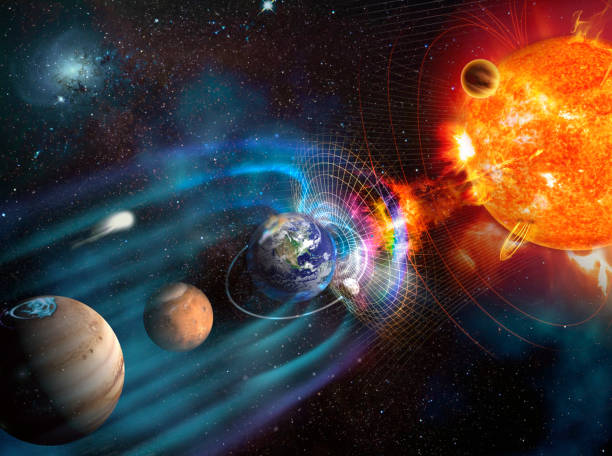
Magnetic lines of force surrounding Earth known as the magnetosphere against Sun’s solar wind. Elements of this image furnished by NASA.
A geomagnetic storm is a natural phenomenon that occurs during the solar maximum period when solar activity becomes active. These storms can have a major impact on technologies that rely on precise location information, such as GPS systems. During geomagnetic storms, the Earth’s magnetic field is disturbed, causing disturbances in the ionosphere and other layers of the atmosphere. This can cause signal delays and errors and affect GPS accuracy.
Geomagnetic storms can cause speeding, affect GPS accuracy, and more. This happens when the GPS device calculates too high or too low a velocity, causing errors in navigation and positioning. During geomagnetic storms, the signals your GPS device receives from satellites can be distorted, which can lead to inaccurate speed readings. This can be especially problematic in applications such as aerospace where accurate speed measurements are essential for safe operation. Other industries where this can cause issues is GPS devices fitted with tracking systems as part of an In-Vehicle-Monitoring-System or IVMS, especially where speed violations occur.
Several approaches can be used to verify speeding during geomagnetic storms. One way is to compare GPS data with data from other sources such as ground radar and inertial navigation systems. These systems can provide independent velocity and position measurements that can be used to validate GPS data during geomagnetic storms.
Another approach is to use statistical techniques to detect anomalies in GPS data. For example, algorithms can be developed to identify sudden changes in velocity or position that do not match the expected pattern. These anomalies can be flagged for further investigation to determine if they are due to geomagnetic storms or other factors.
In addition to speeding tests, it is also important to develop strategies to mitigate the impact of geomagnetic storms on GPS accuracy. One approach is to use sophisticated algorithms that can filter out signal interference and other noise sources. These algorithms can be developed to identify and correct errors in GPS data to improve accuracy and reliability during geomagnetic storms.
Geomagnetic storms during the solar maximum can pose significant challenges to GPS accuracy, but there are strategies that can be used to validate speed violations and mitigate their effects. By evolving and refining these strategies, GPS systems can remain reliable and effective in the face of natural disturbances such as geomagnetic storms.
 “In the civil & mining sector, efficiency and safety are our top priorities. Digicore has been a cornerstone of our operations, providing us with cutting-edge IVMS solutions. What impresses us the most is their ability to comprehend our unique challenges and design solutions that are both effective and cost-efficient. Their after-sales support is exceptional - always reachable, always proactive. It's a pleasure to partner with such a trustworthy, 100% Australian owned company.”
 “We have worked with Digicore for over the last 10 years and at every stage they have come up with innovative and price effective ways in which to help our business. As we grew, our demands grew and Dan from Digicore continued to provide excellent service and the best products.”
 “I want to say thank you for the phenomenal service and input Digicore has had, it has been particularly helpful in providing input to our business IVMS plans. Your team were incredibly professional and Digicore IVMS 2.0 is a very impressive solution.”
 “We started with a large tracking company and got locked in before discovering their units didn't have the functions we required. We switched to Digicore and we couldn't be happier. The product is excellent, pricing is very competitive but more importantly their product knowledge and support is second to none.”